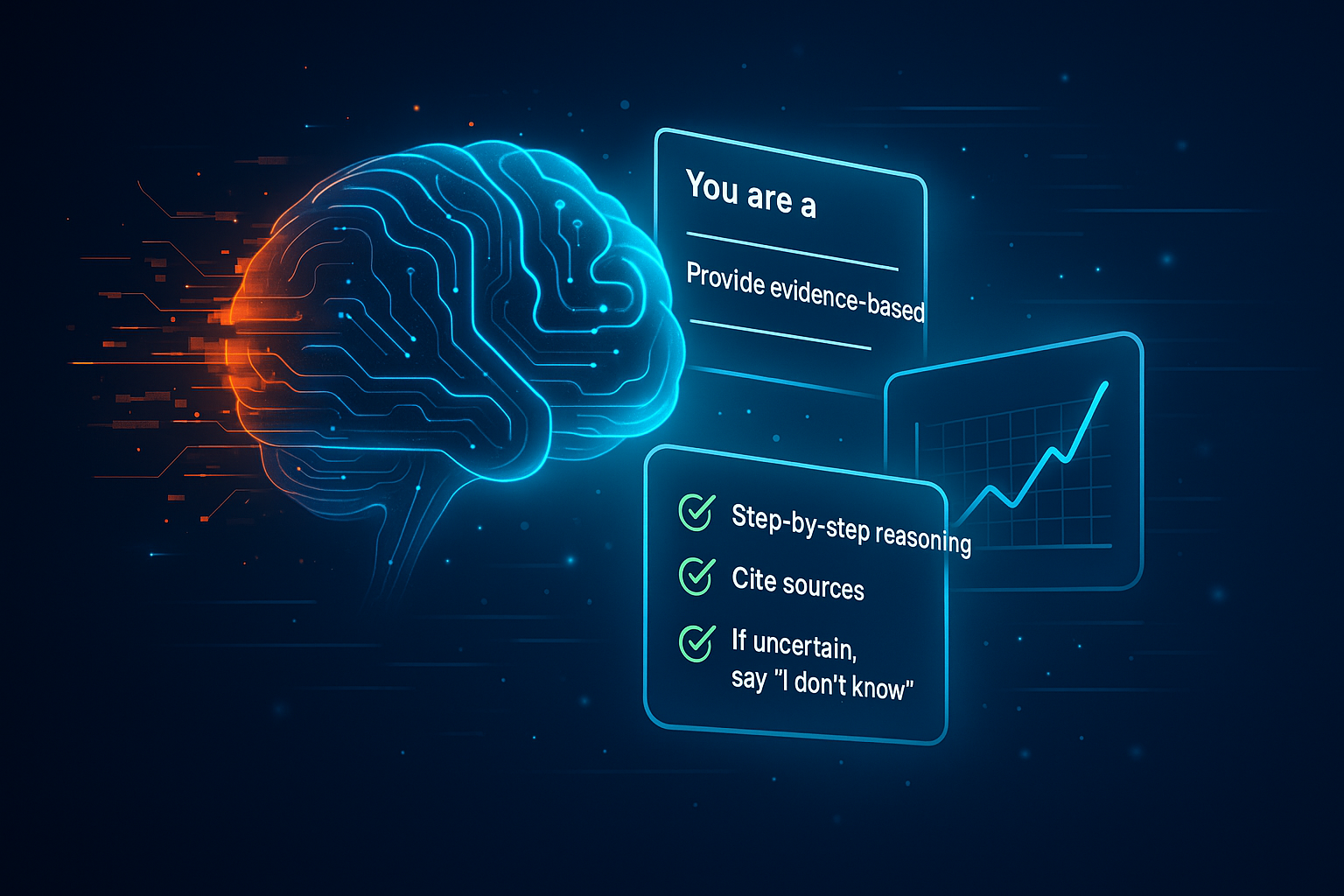
What Are AI Hallucinations and Why Do They Matter?
AI hallucinations occur when artificial intelligence systems generate responses that sound convincing but contain factually incorrect information. For businesses, content creators, and decision-makers, these false outputs can damage credibility, create legal risks, and waste valuable resources.
The solution isn’t waiting for better AI models—it’s mastering prompt engineering techniques that dramatically reduce hallucinations without changing the underlying technology.
Why Prompt Engineering Is Critical for AI Accuracy
Most people assume AI accuracy depends solely on having a “smarter model.” This is only half the story.
The reality: How you communicate with AI models is equally important. Vague or open-ended instructions cause AI systems to fill knowledge gaps with educated guesses, leading to hallucinations. Strategic prompt engineering guides AI to use structured reasoning, cite sources, and avoid fabricating information.
Evidence-Based Methods to Reduce AI Hallucinations
1. Assign Specific Roles to Improve AI Reasoning
Instead of: “Tell me about diabetes treatments”
Try this: “You are a licensed medical researcher with 10+ years of experience. Provide evidence-based diabetes treatments with peer-reviewed sources.”
Why it works: Role-based prompts help AI adopt expert mindsets, improving reasoning quality and reducing random speculation.
Quick implementation: Use specific roles like “senior software developer,” “certified financial advisor,” or “academic historian” based on your needs.
2. Require Step-by-Step Reasoning (Chain-of-Thought Prompting)
AI models often jump to conclusions. Force them to show their work:
Prompt structure: “Explain your reasoning step-by-step before providing your final answer.”
Research backing: Microsoft Research (2024) found that chain-of-thought prompts reduce hallucinations by 30-40% in production environments.
Implementation tip: Even simple phrases like “show your work” or “think through this logically” can significantly improve accuracy.
3. Demand Source Citations for Factual Claims
Effective prompt: “Include at least two reputable sources with specific citations for each factual claim in your response.”
Why this reduces hallucinations: Requiring sources forces AI to search its training data for verifiable information rather than generating plausible-sounding content.
Advanced technique: Request sources in specific formats (APA, MLA) or ask for clickable hyperlinks when possible.
4. Provide Context Instead of Assuming AI Knowledge
Common mistake: Expecting AI to know your company’s internal policies, recent industry changes, or proprietary information.
Better approach: “Using the following company security policy document, summarize the requirements for new hire onboarding: [insert policy text]”
Best practice: Implement Retrieval-Augmented Generation (RAG) systems for knowledge-intensive workflows.
5. Use Explicit Negative Instructions
Powerful technique: Tell AI what NOT to do:
“Answer only if you are certain about the facts. If you don’t know something, explicitly state ‘I don’t have reliable information about this.’ Do not speculate or make educated guesses.”
Industry application: This method is particularly effective in healthcare, legal, and financial contexts where accuracy is critical.
6. Set Clear Scope and Format Limitations
Problem: Broad questions encourage creative but potentially inaccurate responses.
Solution: “List exactly 3 FDA-approved medications for Type 2 diabetes. For each medication, provide: generic name, brand name, and one-sentence mechanism of action.”
Key elements: Specify word counts, response formats (bullet points, tables), and exact deliverables.
7. Implement AI Self-Validation Prompts
Don’t accept first responses blindly. Use follow-up prompts:
“Review your previous answer for factual accuracy. Identify any claims you’re uncertain about and mark them clearly.”
Why this works: AI models often catch their own errors when prompted to self-evaluate, especially for complex or technical content.
8. Integrate External Knowledge Sources (RAG Implementation)
For high-stakes applications: Connect AI to verified external databases, company knowledge bases, or real-time information sources.
Example prompt: “Using the attached customer feedback database, identify the top 3 product complaints from the last quarter with supporting data.”
Impact: Meta AI research (2024) shows RAG systems can reduce hallucinations by over 50% in knowledge-intensive tasks.
9. Develop Systematic Testing and Refinement Processes
Create a feedback loop:
- Track where hallucinations occur most frequently
- Test prompt variations with controlled inputs
- Measure accuracy improvements quantitatively
- Build reusable prompt templates for common tasks
Business impact: Accenture (2024) reported that systematic prompt refinement reduced factual errors by 35% and saved $2 million annually in compliance costs for financial services clients.
Real-World Results: Does Prompt Engineering Actually Work?
Research evidence:
- Microsoft Research (2024): Role-based prompting reduced hallucinations by 30-40%
- Meta AI (2024): RAG + structured prompts cut hallucination rates in half
- Accenture Financial Services Study (2024): 35% error reduction, $2M annual savings
The Future of AI Hallucination Mitigation
While completely eliminating AI hallucinations remains challenging, emerging developments include:
- Self-validating AI models with built-in fact-checking
- Advanced retrieval systems with real-time verification
- Industry-specific AI models trained on curated datasets
Current reality: Prompt engineering remains the most accessible and cost-effective method for improving AI reliability.
Conclusion: Take Control of AI Accuracy
AI hallucinations don’t have to undermine your work quality or business outcomes. These 9 evidence-based prompt engineering methods can dramatically improve AI accuracy, reduce risk, and increase confidence in AI-generated content.
Next steps: Bookmark this guide, implement the immediate actions checklist, and start building more reliable AI workflows today.
Frequently Asked Questions
What are AI hallucinations?
AI hallucinations are incorrect or fabricated responses generated by language models that appear confident but are factually inaccurate.
Can prompt engineering reduce AI hallucinations?
Yes, structured prompt engineering methods like role-based instructions, step-by-step reasoning, and requiring sources can reduce AI hallucinations by up to 30–40%.
What is the most effective prompt engineering technique?
Combining role instructions, source requirements, and external data integration through Retrieval-Augmented Generation (RAG) provides the most significant reduction in hallucinations.
Do I need technical skills for prompt engineering?
No, prompt engineering is primarily about designing clear instructions for the AI. You can start with simple techniques like adding roles, asking for sources, and limiting the scope of answers.
Where can I use these prompt engineering techniques?
These techniques are useful for content creation, research assistance, customer support automation, educational applications, and any scenario where factual accuracy is critical.